Rugby’s Greatest Rivalry trophy unveiled in two magnetic halves
The Springboks and All Blacks will contest a trophy made from two magnetic blades, with the four-Test series winner receiving both halves.
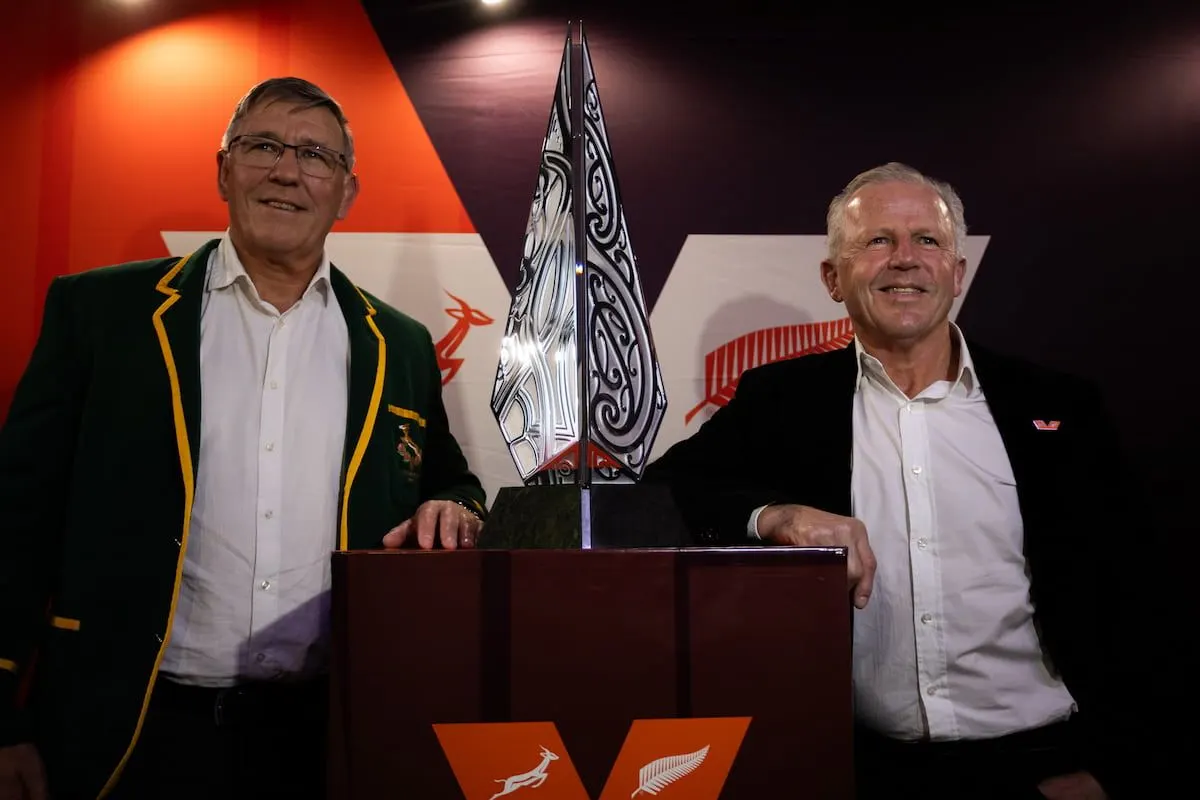
A new trophy for Rugby’s Greatest Rivalry has been unveiled in Johannesburg ahead of the revival of tours between South Africa and New Zealand. The creation is made from two separate halves that are drawn together by hidden magnets, turning the object itself into a representation of the long-running contest between the Springboks and All Blacks.
The trophy was brought together publicly for the first time by Gary Teichmann and Sean Fitzpatrick, the captains of the teams during the 1996 series. It will be awarded after the fourth Test in Baltimore, United States, on 12 September. The team that wins the four-Test tour will receive both halves of the trophy. If the series is drawn, each country will retain one half.
That possibility was central to the design. The trophy was created specifically for the return of tours between the two nations, whose rugby identities have developed separately while remaining closely connected. Its two blades can stand independently, with each representing the culture, history and identity of its country. When placed together, they form a single complete trophy.
The shape is based on a blade of grass, an element shared by every rugby player. Strategy Creative of New Zealand developed the design with the two unions. Each blade was precision-machined from solid aluminium, while the magnets concealed inside the pieces pull them together when they are placed near each other. The mechanism gives the trophy a physical connection that mirrors the repeated meetings between the teams.
The South African half carries artwork by Bonolo Chepape. Her work examines the idea that sporting greatness is not achieved alone. Layered patterns inspired by community, culture and shared experience represent the people who contribute to sporting excellence in South Africa, extending the meaning of the trophy beyond the players who eventually lift it.
The New Zealand blade features artwork by Kereama Taepa. It draws on the Māori creation story of Tāne and Whiro, two brothers who pursue the same goal by different paths. The design reflects the tension, respect and connection associated with a major rivalry, while adding a specifically Māori cultural reference to the All Blacks half of the trophy.
The base also follows the theme of two parts forming a larger whole. It is made from two distinct stones: black Pakohe stone from Aotearoa New Zealand and green Verdite from South Africa. Together with the aluminium blades and their separate artworks, the base gives each nation a distinct physical presence while keeping the two pieces within one design.
The choice to allow a drawn series to remain shared also acknowledges the history of the fixture. The first tours between the teams, in 1921 and 1928, were shared. The upcoming contest is the eighth four-Test tour in 12 meetings between the nations, and the trophy’s rules avoid deciding a tied series through a separate or arbitrary measure after four Tests.
The trophy will be shown to the public for the first time when South Africa face New Zealand in the opening Test at 10bet Ellis Park in Johannesburg on Saturday. The four-Test series will then conclude at Baltimore on 12 September, when the final result will determine whether the complete trophy travels to one nation or its two halves remain divided between both.
Source: The South African — Sport